aijō.Studio
SMART MATERIALS FOR ADAPTIVE ARCHITECTURE AND DESIGN
NOVEL AIR PUMPED ACTUATOR DISRUPTS DESIGN AND ARCHITECTURE.
A bridge is being built between science and design.
Material is the first INTERFACE between the individual and the environment.
The insertion of technology in the material raises the questions about the nature of human-computer interaction as it changes our SENSORY EXPERIENCE and our PERCEPTION OF THE OBJECT.
This new technology of soft actuator offers potential for the creation of more ORGANIC AND LIVING ENTITIES.
LIVING MATTER
EMBEDDED ORGANIC TECHNOLOGY

The subtle flexibility of the actuators amplifies the response of the object because it ADAPTS better to human needs and behaviors.
The research presented here, explores the possibilities offered in terms of movement, aesthetics and sensory experience paving ways for disruptive design in MEDECINE, ARCHITECTURE & PRODUCT DESIGN.


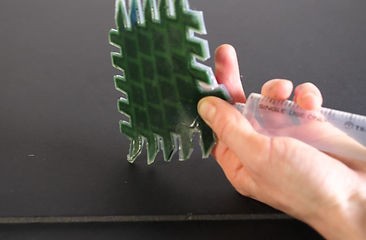
The SOFT ACTUATOR are made up of a series of channels and chambers inside an elastomer.
These channels inflate when pressurized or depressurized, creating MOTION.
The nature of this motion is controlled by modifying the geometry of the embedded chambers and the material properties of their surfaces.
Experimentations were made with different silicone and fabric stiffness:
A stiffer surface opposed to a soft opposite surface reinforced the motion.
The "stretchy" material expands more than the "rigid" material when the actuator is pressurized. The "differential strain" effect can be used to achieve useful motions such as bending and twisting.
ADVANTAGES: Mechanical properties include softer movements and more accurate control over the system, especially with delicate material. Applications in medical device is thus a strong prospect of development (soft robotics).

Fabrication process

3D PRINTED MOLDS
The molds are designed in Rhino and printed in a Zortrax 3D printer.

Silicone is poured into the mold after being dyed with pigment.
The shapes are inspired by origami and altered geometric shapes.
Object design
Creating fairy creatures from geometric shapes.
I used the folding of origami to identify the best technique to fold the silicone material and to create animal-like mini objects.
I found inspiration in the elements of nature such as marine animals, jellyfishes, octopus, ducks. Magically a flat octogon becomes a jellyfish, a flat circle becomes a fat tiny duck, a random shape becomes a blossoming flower.